
When Space Isn’t Safe
What the ESA Breach Means for Orbital Infrastructure
by IsyChain Team
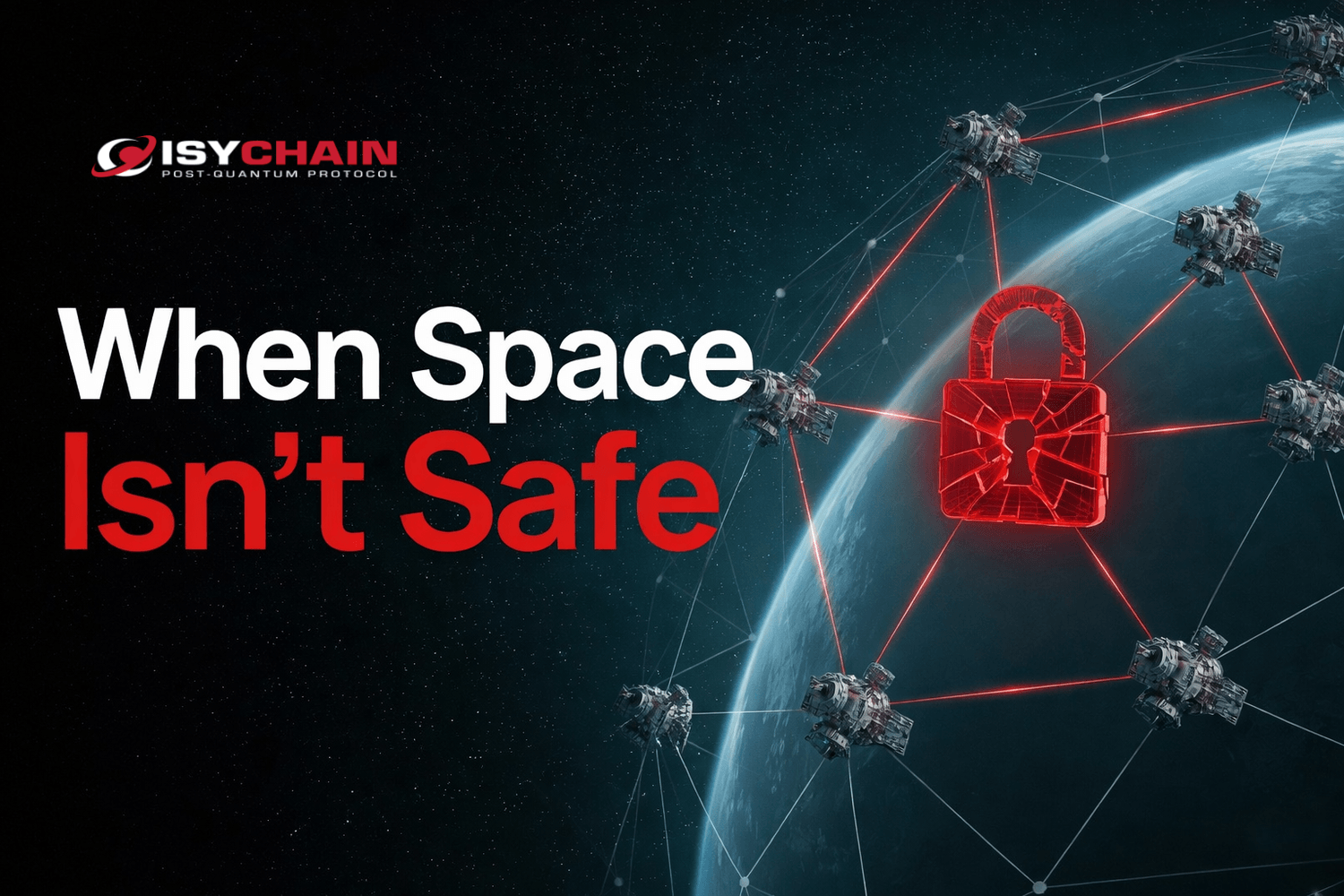
The global space community is transforming from a niche exploration sector into the backbone of critical global infrastructure. If your organization relies on international finance, energy grids, or global supply chains, you fundamentally rely on space. However, as our orbital networks become indispensable, they simultaneously become highly contested targets.
The (https://www.infosecurity-magazine.com/news/european-space-agency-confirms/) shattered the illusion that aerospace environments are immune to modern threats. When hackers exfiltrated 700GB of mission data, it exposed the fragility of centralized, Earth-bound trust architectures. Securing our space infrastructure requires a radical shift. We must move trust anchors off the planet entirely, establishing a decentralized orbital trust architecture. Only native, space-centric security ensures your mission-critical operations survive.
The ESA Breaches: A Timeline of Systemic Failure
The cyber intrusion into the ESA unfolded as a multi-stage operational failure that highlighted systemic vulnerabilities within collaborative engineering environments.
Phase 1 (December 2025): A threat actor operating under the alias "888" posted over 200 gigabytes of stolen ESA data. The agency attempted to minimize the incident, claiming it impacted "unclassified" systems. However, the haul included deeply sensitive infrastructure blueprints: a complete dump of private Bitbucket repositories, Continuous Integration/Continuous Deployment (CI/CD) pipelines, active API keys, and (https://www.paubox.com/blog/european-space-agency-confirms-data-breach-after-hacker-claims-200gb-of-stolen-data).
Phase 2 (January 2026): The cybercrime collective "Scattered Lapsus$ Hunters" exploited remaining vulnerabilities to steal an additional 500 gigabytes of data. This secondary strike exposed the Ariel space telescope mission scheduled for 2029, alongside proprietary contractor data from SpaceX, Airbus, and Thales Alenia Space.
How Traditional Perimeters Failed
The breach highlights exactly how legacy security models fail the modern aerospace sector. The kill chain relied on bypassing traditional defenses:
Infostealer Malware: Threat actors likely harvested active session cookies via advanced infostealer malware, which effortlessly evades traditional anti-virus solutions.
MFA Bypass: Groups like Scattered Lapsus$ Hunters are notorious for weaponizing MFA flows, using social engineering to trick targets into approving prompts, effectively bypassing multi-factor protections.
Lateral Movement: Developers had embedded hardcoded credentials directly into source code, granting attackers frictionless movement across interconnected contractor portals and databases.
The Fundamental Flaw: Earth-Bound Trust Anchors
The ESA attacks represent a symptom of a broader deterioration in orbital security. Traditional military and space communication networks rely on a centralized, single-point-of-access model.
In legacy architectures, cryptographic keys, certificate authorities, and central command nodes all reside on Earth. This creates an inherently fragile system. When trust is anchored to specific physical locations, advanced perimeter defenses fail because the trust roots themselves are physically accessible or highly centralized. A successful attack on a single terrestrial node can lead to widespread, systemic failure across an entire orbital constellation.
Architecting Decentralized Orbital Trust
To mitigate these vulnerabilities, the aerospace sector must transition toward decentralized orbital trust architectures. By deploying blockchain technology directly across a constellation, satellites cease to be passive transponders and instead function as independent, cryptographic nodes.
Elimination of Single Points of Failure: Decentralized architectures remove central control points. If a ground station is compromised, the orbital network autonomously rejects unauthorized commands because they fail to achieve cryptographic consensus.
Immutability and Transparency: All operational commands and data transfers are verified on an immutable ledger, mathematically protecting transmissions from unauthorized alteration.
Virtual Trusted Zones: Blockchain facilitates secure "virtual trusted zones" in space, which is critical for coordinating satellite swarms that must share telemetry data across different orbits without routing it back to vulnerable Earth stations.
Why It Matters: Securing the Orbital Edge
To move beyond vulnerable Earth-bound anchors, we are delivering a definitive trust layer for the orbital edge. These advancements matter because they give you mathematically unbreakable security through a proprietary network built for the future:
Space-Centric Security: We provide decentralized cryptographic trust across space-native nodes, eliminating the single points of failure that limit Earth-bound key management.
Quantum-Resistant Layer-1: We combine optical entropy with NIST-standardized algorithms to deliver post-quantum cryptography natively at Layer-1.
High-Performance Execution: Our architecture is scalable to 1.5 million transactions per second (TPS) with sub-2 second finality, which is essential for your real-time orbital and terrestrial coordination.
Tokenized Orbital Asset Registry: We are deploying an autonomous trust mesh on Orbital Edge Nodes, allowing your satellites to continuously validate one another and enabling provable multi-agency trust.
