
Anatomy of 'Harvest Now, Decrypt Later' Attack
An Enterprise Threat Briefing
by IsyChain Team
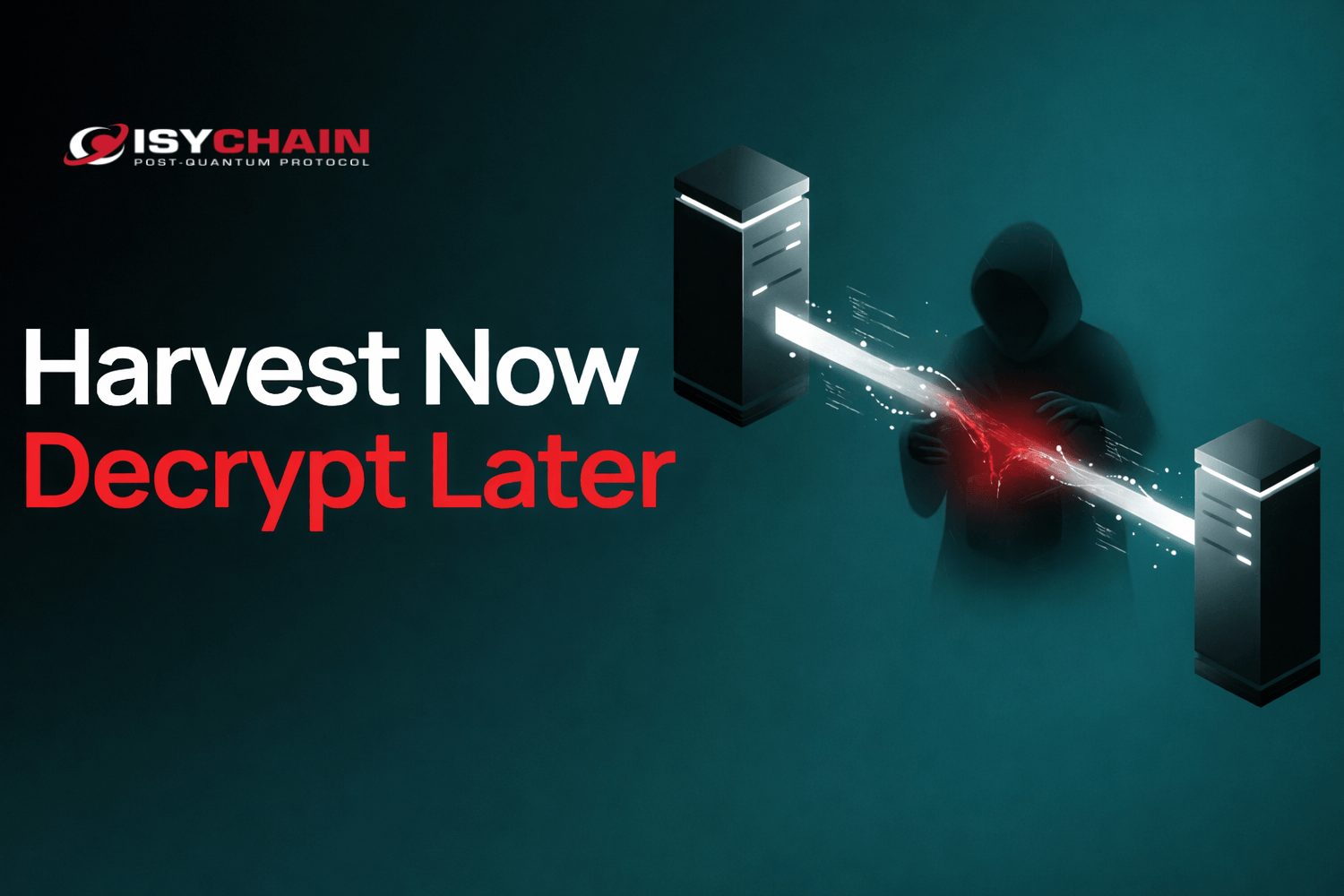
We are standing at the precipice of a cryptographic epoch. While we build the decentralized networks of tomorrow, a silent, pervasive threat is actively undermining our digital present. Every single day, state-sponsored actors are quietly siphoning your enterprise’s most sensitive encrypted data. This is not a theoretical scenario reserved for the future; it is a meticulously executed campaign known as the "Harvest Now, Decrypt Later" (HNDL) attack. The vulnerability is not waiting for a quantum computer to be built—it exists today, at the very moment your data is exfiltrated.
We recently reached a critical milestone in our defense. In August 2024, the National Institute of Standards and Technology (NIST) finalized its post-quantum cryptography (PQC) standards, giving us the mathematical blueprints to fight back. But updating math is only the beginning. To truly secure our decentralized future, you need a visionary approach that combines post-quantum encapsulation with physically isolated, space-centric trust architectures.
In this briefing, we will break down exactly how adversaries are warehousing your data for the quantum era, the mechanics of their network exploitation, and the immediate enterprise mitigation roadmap you must implement to survive the transition.
The Mechanics of Harvest Now, Decrypt Later (HNDL)
The HNDL threat model fundamentally alters how you must view encrypted data. It treats traditional encryption not as an unbreakable vault, but merely as a time-delay mechanism. The attack lifecycle operates in three distinct, patient phases:
Phase 1: Harvest: Attackers intercept your network traffic using endpoint exploits, network taps, or by manipulating internet routing. Because the information is encrypted, they do not attempt to break it immediately.
Phase 2: Store: The harvested ciphertext is archived in state-aligned hyperscale data centers. The data may sit there for decades, waiting for quantum decryption to become practical.
Phase 3: Decrypt: Once Cryptographically Relevant Quantum Computers (CRQCs) are capable of running Shor's algorithm, adversaries will derive your private keys from the public keys. Data that was secure for years suddenly becomes readable.
How They Harvest: TLS Downgrades and Interception
To ensure the data they steal today is as easy to decrypt as possible tomorrow, attackers actively weaken your connections before exfiltrating the payloads. They achieve this primarily through TLS Downgrade Attacks.
The Downgrade Dance: Operating as a Man-in-the-Middle (MITM), adversaries intercept your initial connection handshake and trick your server into believing that only obsolete protocols are supported.
Protocol Rollback: This forces your systems to revert to highly vulnerable standards—such as SSL 3.0 (exploited in the POODLE attack) or 512-bit export cryptography (exploited in Logjam).
Quantum Weakening: By forcing older protocol versions, attackers ensure that the cryptographic complexity required to break the data in the future is drastically reduced.
Who is Harvesting Your Data? The APT Threat
You are not fighting isolated cybercriminals; you are targeted by highly organized, state-sponsored Advanced Persistent Threat (APT) groups focused heavily on economic subversion, technological theft, and national security.
Mass-Scale Exfiltration: Groups like APT41 and APT29 (Cozy Bear) run industrialized global data harvesting campaigns. They frequently target third-party software vendors to gain stealthy, long-term access to secure enterprise environments.
Evasion Tactics: To hide their harvesting operations, APT actors open non-standard ports to expose services like SSH or RDP. This secures multiple avenues for silent data exfiltration without triggering your standard security monitoring tools.
Integrating Post-Quantum Encapsulation (ML-KEM)
To defend against the decryption phase of HNDL, you must eliminate the vulnerability in your public-key cryptography. NIST’s finalized FIPS 203 standardizes the Module-Lattice-Based Key-Encapsulation Mechanism (ML-KEM), providing a quantum-proof mathematical defense.
Because ML-KEM is a software-deployable algorithm, it runs seamlessly on your existing classical hardware, entirely avoiding the extreme costs of specialized optical hardware. The integration benefits your enterprise in several ways:
Flexible Security Parameters: You can deploy ML-KEM-512 (baseline), ML-KEM-768 (standard enterprise), or ML-KEM-1024 (maximum security) depending on your payload requirements.
The Hybrid Mandate: Because PQC is relatively new, you must use a Hybrid Cryptographic Architecture. In TLS 1.3, your system will execute a classical algorithm (like X25519) in parallel with a post-quantum algorithm (like ML-KEM-768).
Dual Protection: The handshake binds both results. If the quantum computer breaks the classical curve, your data remains secure behind ML-KEM. If a flaw is found in ML-KEM, the classical curve continues to protect you.
Your Quantum-Safe Mitigation Roadmap
Migrating an enterprise to post-quantum standards requires a structured roadmap to achieve crypto-agility. You must take these steps immediately:
Deploy Cryptographic Inventory: You cannot secure what you cannot see. Use Automated Cryptography Discovery and Inventory (ACDI) tools to scan your cloud and on-premises environments, cataloging every instance of TLS, SSH, and VPNs.
Execute Risk Prioritization: Assess your data's "quantum-vault risk." Prioritize systems handling data with a long intelligence shelf-life, assigning a Quantum Security Level (QSL) to all components.
Design Hybrid Architectures: Work with your vendors to mandate hybrid key exchange protocols (like X25519MLKEM768) across your network edge.
Launch Pilot Deployments: Test your ML-KEM integrations in controlled sandboxes. Resolve any packet fragmentation issues or middlebox incompatibilities before deploying to live production networks.
Enable Continuous Monitoring: Cryptographic agility must become a core capability. Upgrade your SIEM tools to monitor larger key exchange logs and detect signature validation failures.
Beyond Math: Securing Trust in Space with IsyChain
Updating your algorithms resolves the mathematical vulnerability of HNDL, but it leaves a critical structural flaw exposed: physical centralization. A mathematically unbreakable ML-KEM lock means nothing if the attacker can physically breach the terrestrial data center holding the key.
We must physically isolate our trust layers. At iSyChain, we secure decentralized stacks and legacy systems by moving the ultimate authority off-planet.
Space-Centric Key Custody: We deploy an autonomous, post-quantum trust mesh operating on Orbital Edge Nodes. By elevating trust anchors to Low Earth Orbit satellites, we make them functionally immune to terrestrial cyber attacks, hardware theft, and geopolitical coercion.
AI-Driven PoHM™ Consensus: Our sovereign blockchain replaces legacy consensus mechanisms with Proof of Health/Machine (PoHM™). In space, our satellite nodes continuously validate one another using AI-driven telemetry, forming a Tokenized Orbital Asset Registry.
Unbreakable Medical & Enterprise Trust: Devices, applications, and data flows continuously prove their integrity through PoHM™ consensus, enabling tamper-resistant records and real-time threat detection without disrupting your operational workflows.
